
Welcome to Rosenthal Law, PLLC
Protecting Families. Defending Rights. Michigan Law You Can Trust.




Who we are
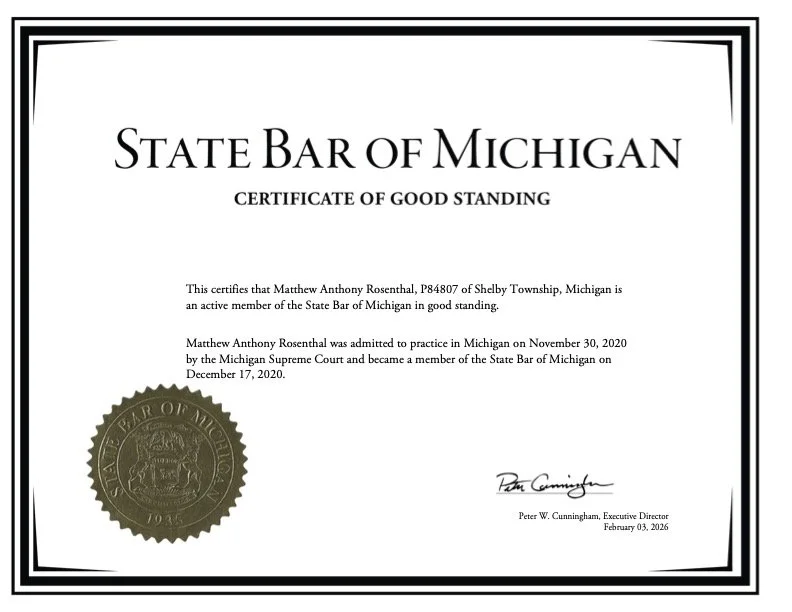
Matthew A. Rosenthal is a battle-tested courtroom attorney who stands between his clients and the power of the legal system. As the founder of Rosenthal Law, PLLC, he focuses his practice on family law and criminal defense, providing strong courtroom advocacy combined with practical, straightforward advice.
Matthew understands that clients often come to him during stressful and uncertain times — whether they are facing criminal charges, a custody dispute, or another serious legal matter. He believes every client deserves to be heard, informed, and represented with preparation, strategy, and determination. When your freedom, your children, or your future is on the line, you need more than paperwork and phone calls — you need a lawyer who is prepared to fight in court.
Proven Courtroom Experience
Matthew’s legal career was built inside courtrooms. As an Assistant Corporation Counsel for the City of Detroit, he served as a prosecutor in the 36th District Court, handling criminal cases from start to finish. He conducted trials, evidentiary hearings, and motion arguments, gaining firsthand knowledge of how the government prepares and prosecutes cases.
That prosecutorial experience now works in his clients’ favor. He understands the strategies used by the other side — and how to challenge them.
After his time as a Detroit prosecutor, he then entered private practice representing clients throughout Michigan as an attorney at Goldman and Associates, one of the largest family law firms in Michigan. While there he handled hundreds of family law and criminal defense cases. He has stood in court on behalf of hundreds of clients, advocating when the stakes were deeply personal and the outcomes life-changing.
A Veteran Who Understands Service and Sacrifice
Matthew is also a proud United States Air Force veteran, honorably discharged after serving as an Airman First Class stationed overseas at Ramstein Air Force Base in Germany. His military service instilled discipline, accountability, and a deep respect for those who serve.
He has worked closely with Veterans Treatment Court programs throughout Michigan, helping veterans facing criminal charges find structured support while still holding them accountable. He understands both the pressures of service and the importance of second chances.
Education Backed by Leadership
Matthew earned his Juris Doctor from Syracuse University College of Law, where he received the Life Achievement Scholarship and served as a Student Bar Association Senator. He also holds a Bachelor of Business Administration with Distinction from the University of Michigan, giving him a strong foundation when handling family law cases involving financial and property issues.

Our Practice Areas
Serving ALL Michigan counties including Wayne, Oakland, Macomb, Kent, Genesee, Washtenaw, Ottawa, Kalamazoo Ingham, Livingston, Saginaw, Muskegon, St. Clair, Jackson Berrien, Monroe, Calhoun, Allegan, Eaton and Bay County
-
Matthew A. Rosenthal is an experienced criminal defense attorney serving clients throughout Michigan. A former Detroit prosecutor, he brings insider knowledge, strategic defense, and confident courtroom advocacy to every case. When your freedom and reputation are on the line, Matthew fights for smart, effective results at every stage.
Felonies/misdemeanors/civil infractions including OWI, probation violation, domestic violence, assault/battery, firearms/weapons, drugs, traffic violations and more.
-
Matthew A. Rosenthal is a dedicated family law attorney representing clients across Michigan in divorce, custody, parenting time, support, and guardianship matters. He combines compassionate guidance with strong courtroom advocacy to help families navigate difficult transitions with clarity and confidence. Matthew is committed to protecting what matters most — your children, your future, and your peace of mind.
Divorce, child custody, child support, alimony, military divorce, guardianships.
-
Personal protection orders, depositions
Contact Us
If you are facing criminal charges or a serious family law dispute in Michigan, Rosenthal Law, PLLC is ready to stand with you — and, when necessary, stand up for you in court. Please call or email for a complimentary initial consultation.
Matt@rosenthalattorney.com
(248) 965-5513

Mission Statement
Every legal matter is personal, and every client deserves to be heard. At Rosenthal Law, PLLC, we take the time to understand your goals, explain your options clearly, and build a strategy designed around your needs. From family law matters that impact your home and children to criminal cases that affect your freedom and reputation, we stand beside you with knowledgeable guidance and strong advocacy every step of the way.
When your future is on the line, experience and preparation matter. Rosenthal Law, PLLC delivers focused, results-driven representation in family and criminal law matters. We approach every case with careful strategy, thorough preparation, and a commitment to achieving the best possible outcome. Our mission is simple: provide clear advice, strong advocacy, and dependable legal solutions you can trust.
Please call (248) 965-5513 for a complimentary initial consultation regarding your legal needs.
Frequently Asked Questions
At Rosenthal Law we understand that hiring a lawyer can feel overwhelming. Below are answers to common questions about family law and criminal law matters. If you don’t see your question here, contact us — we’re here to help.
Family Law
Family law issues can be some of the most emotional and life-changing legal matters a person will ever face. Whether you are considering divorce, dealing with a custody dispute, or seeking guardianship of a loved one, understanding how Michigan family law works can help you feel more prepared and confident about your next steps.
Divorce in Michigan
Michigan is a no-fault divorce state, which means that a spouse does not need to prove wrongdoing to file for divorce. Instead, the filing party must state that the marriage has broken down to the point that there is no reasonable chance of reconciliation.
Even in no-fault cases, divorce can involve complex decisions about:
Division of property and debts
Spousal support (alimony)
Child custody and parenting time
Child support
Michigan courts aim for a fair and equitable division of marital property, which does not always mean a 50/50 split. Factors such as the length of the marriage, each spouse’s contributions, and future earning ability can all play a role. Considering divorce? Rosenthal Law, PLLC provides compassionate guidance and aggressive representation.
How Does Child Custody and Parenting Time Work?
When children are involved, the court’s primary focus is always the best interests of the child. Michigan law outlines several factors judges consider when determining custody, including:
The emotional ties between parent and child
Each parent’s ability to provide stability
The child’s home, school, and community record
Each parent’s willingness to support the child’s relationship with the other parent
Child Support
Both parents have a legal duty to financially support their children. Michigan uses a formula called the Michigan Child Support Formula, which considers:
Each parent’s income
Number of overnights the child spends with each parent
Healthcare and childcare costs
Support orders can be modified if there has been a significant change in circumstances, such as a job loss or major shift in parenting time.
Spousal Support (Alimony)
Spousal support is not automatic in Michigan. Courts look at several factors, including:
Length of the marriage
Each party’s income and earning capacity
Age and health of the spouses
Standard of living during the marriage
The goal is generally to ensure that neither party is left in severe financial hardship following a divorce.
Guardianships and Juvenile Matters
Family law in Michigan can also include guardianships for minors when parents are unable to care for a child, as well as juvenile court matters. These cases can be especially sensitive and often require careful legal guidance to protect the child’s well-being and the rights of those involved.
Custody Battles
Few legal disputes are as personal or stressful as a child custody battle. When parents cannot agree on custody or parenting time, Michigan courts step in with one guiding principle: the best interests of the child.
What Is the Difference Between Legal Custody vs. Physical Custody?
In Michigan, custody is divided into two parts:
Legal Custody – The right to make major decisions about a child’s life, including education, medical care, and religious upbringing. Courts often award joint legal custody, meaning both parents share decision-making.
Physical Custody – Where the child lives on a day-to-day basis. This may be:
Joint physical custody (the child spends substantial time with both parents), or
Sole physical custody (the child primarily lives with one parent)
Even when one parent has primary physical custody, the other parent is usually granted parenting time unless there are serious safety concerns.
What Are the “Best Interests of the Child” Factors?
Michigan law requires judges to evaluate specific factors to determine custody. No single factor automatically wins a case. Instead, the court looks at the full picture of the child’s life.
Some of the key factors include:
The emotional ties between each parent and the child
Each parent’s ability to provide love, guidance, and support
The child’s need for stability and continuity in their home, school, and community
Each parent’s mental and physical health
Each parent’s willingness to encourage a positive relationship between the child and the other parent
Any history of domestic violence
The child’s preference (depending on age and maturity)
Courts are not focused on which parent is “better” overall — they are focused on which environment best supports the child’s healthy development.
What Is an Established Custodial Environment?
A major concept in Michigan custody cases is the Established Custodial Environment (ECE). This refers to the home where the child has been receiving consistent care, stability, and guidance.
If a parent wants to change an existing custody arrangement that would disrupt the child’s established environment, they must meet a higher legal standard. This can make modifying custody more difficult once an arrangement is in place.
What Is the Importance of Parenting Time?
Even when parents share custody, disagreements about parenting time schedules are common. Courts want children to maintain strong relationships with both parents whenever possible.
If one parent repeatedly interferes with court-ordered parenting time, the other parent can seek enforcement through the Friend of the Court or by filing a motion with the judge.
How to Strengthen Your Custody Case
Parents involved in a custody dispute should focus on showing the court that they are stable, involved, and child-focused. This includes:
Maintaining consistent involvement in your child’s school and activities
Keeping a safe and appropriate home environment
Communicating respectfully with the other parent when possible
Following existing court orders
Avoiding negative comments about the other parent in front of the child
Judges pay close attention to which parent is more likely to put the child’s needs ahead of personal conflict.
What Should I Expect During a Friend of the Court Investigation in Michigan?
If you are involved in a custody or parenting time dispute in Michigan, you may be told that your case is being referred to the Friend of the Court (FOC) for an investigation. For many parents, this can feel intimidating or confusing. Understanding the process can help you prepare and avoid common mistakes.
What Is the Friend of the Court?
The Friend of the Court is a division of the circuit court that assists judges in family law matters involving children. The FOC does not represent either parent. Instead, it acts as a neutral investigator and advisor to the judge.
In custody and parenting time disputes, the judge may ask the FOC to:
Investigate each parent’s home and circumstances
Interview the parents (and sometimes the child)
Review school, medical, or other relevant records
Make a recommendation about custody and parenting time
While the judge makes the final decision, FOC recommendations often carry significant weight.
Why Would a Case Be Referred?
A Friend of the Court investigation is common when parents cannot agree on:
Child custody (legal or physical)
Parenting time schedules
Changes to an existing custody arrangement
The court uses the investigation to gather detailed information about the child’s life and each parent’s ability to meet the child’s needs.
What Happens During the Investigation?
Every county’s process is slightly different, but most investigations include the following steps:
1. Parent Interviews
Both parents will be interviewed separately. You may be asked about:
Your relationship with your child
Your daily routine with the child
Your work schedule and childcare plans
Concerns about the other parent
Your proposed custody and parenting time schedule
Be honest, focused, and child-centered in your answers.
2. Child Interview (Sometimes)
Depending on the child’s age and maturity, the investigator may speak with the child. This is not about letting the child “choose” a parent, but about understanding their experiences, routines, and comfort in each home.
Parents should never coach a child on what to say. Investigators are trained to recognize when a child has been pressured.
3. Home Information
You may be asked about your living arrangements, including:
Who lives in your home
Sleeping arrangements for the child
Safety and stability of the environment
In some cases, a home visit may occur, though this is not always required.
4. Records and Collateral Contacts
The investigator may review:
School records
Medical or counseling records
Police reports (if relevant)
They may also speak with teachers, counselors, or other individuals who regularly interact with your child.
What Is the Friend of the Court Recommendation?
After completing the investigation, the FOC will issue a written recommendation to the court. This typically addresses:
Legal custody (joint or sole)
Physical custody
A detailed parenting time schedule
If both parents accept the recommendation, it can become a court order. If either parent objects, the case proceeds to a court hearing or trial, where the judge makes the final decision.
How Do I Prepare for a Friend of the Court Investigation?
Parents can strengthen their position by:
Staying actively involved in their child’s education, healthcare, and activities
Keeping communication with the other parent respectful and child-focused
Maintaining a safe, stable home environment
Bringing organized documents (school info, medical details, schedules)
Avoiding social media posts that show conflict, substance abuse, or poor judgment
Most importantly, show that you are willing to support your child’s relationship with the other parent — unless there are genuine safety concerns.
Criminal Law
Being charged with a crime in Michigan can be overwhelming and frightening. At Rosenthal Law, we strive to provide the best legal advice to our clients. Whether it’s your first encounter with the legal system or you’ve been through it before, the consequences of a criminal charge can affect your freedom, finances, employment, and reputation. Understanding the basics of how criminal law works in Michigan can help you take the right steps early.
What Do I Do After an Arrest in Michigan?
Being arrested can be one of the most stressful experiences of your life. In the hours and days that follow, the decisions you make can have a major impact on your case. Knowing your rights and taking the right steps early can help protect your future.
1. Stay Calm and Do Not Resist
No matter how upset or confused you feel, do not resist arrest or argue with officers. Resisting can lead to additional charges and make the situation worse. Stay calm and comply with lawful commands.
2. Use Your Right to Remain Silent
You have the constitutional right to remain silent — use it.
You are only required to provide basic identifying information. Beyond that, you do not have to answer questions about where you were, what happened, or who you were with.
Even if you believe you can “clear things up,” statements made in stressful situations are often misunderstood or used against you later. Politely say:
“I am invoking my right to remain silent and would like to speak to an attorney.”
Then stop talking.
3. Ask for an Attorney Immediately
You have the right to have an attorney present during questioning. Once you request a lawyer, police should stop interrogating you.
Do not discuss your case with:
Cellmates
Friends on jail phones
Anyone over recorded jail calls
Those conversations can be recorded and used as evidence.
4. Understand the Arraignment Process
After an arrest, you will typically be brought before a judge for an arraignment. At this hearing:
You are formally told the charges
The judge sets bond and bond conditions
Future court dates are scheduled
Bond conditions may include travel restrictions, no-contact orders, alcohol testing, or other requirements. Violating bond can lead to jail, so it is critical to follow all conditions exactly.
Having an attorney involved before or at arraignment can sometimes help secure a lower bond or more favorable conditions.
5. Do Not Discuss Your Case on Social Media
Prosecutors and investigators regularly check social media. Posts, photos, and messages can be taken out of context and used against you.
6. Gather Information for Your Defense
As soon as possible, write down everything you remember about the incident, including:
Where you were
Who was present
What was said
Timeline of events
Memories fade quickly. These notes can help your attorney build your defense.
Also gather:
Names and contact information of witnesses
Any photos, videos, or receipts that support your whereabouts
7. Contact a Criminal Defense Attorney Quickly
Early legal representation can make a major difference. An attorney can:
Review whether the stop, search, or arrest was lawful
Communicate with prosecutors on your behalf
Protect you from making damaging statements
Start building a defense before evidence disappears
The earlier a defense strategy begins, the more options you may have.
Michigan OWI Law
Being charged with an OWI (Operating While Intoxicated) in Michigan can be frightening. The penalties — including jail time, fines, license suspension, and a permanent criminal record — can have long-lasting effects. The good news is that you have rights, and there are several strategies a skilled attorney can use to defend you.
1. Challenge the Traffic Stop
2. Question Field Sobriety Tests (FSTs)
Police often use field sobriety tests to determine if a driver is impaired. Common tests include:
Horizontal gaze nystagmus (eye movement test)
Walk-and-turn
One-leg stand
These tests are not foolproof. Factors like fatigue, nervousness, medical conditions, or even poor instructions can cause a person to “fail” a field sobriety test. An experienced attorney can challenge the reliability and administration of these tests.
3. Challenge Breathalyzer or Blood Test Accuracy
4. Examine Officer Conduct and Evidence Collection
Police mistakes or misconduct can affect your case. Your attorney may investigate.
5. Present Alternative Explanations
Sometimes a defense involves showing that impairment was not caused by alcohol or drugs, but by other factors, such as:
Prescription medication
Medical conditions (e.g., diabetes, vertigo)
Fatigue or distraction
A strong defense attorney can use expert testimony or documentation to support these claims.
6. Negotiate Reduced Charges
In many cases, even if there is evidence against you, an attorney can negotiate with prosecutors for:
Reduced charges (e.g., misdemeanor instead of felony)
Deferred sentences or probation
Alcohol treatment programs in lieu of jail
7. Administrative License Defense
Michigan’s Secretary of State can suspend your license independently of criminal court. A skilled OWI attorney can help:
Challenge the license suspension
Request a restricted or hardship license
Ensure administrative deadlines are met
How do Expungements Work in Michigan?
A criminal record can follow you for years, affecting jobs, housing, education, and professional licenses. Fortunately, Michigan has expanded its expungement laws, giving more people the opportunity for a fresh start.
What Is an Expungement?
An expungement (also called “setting aside a conviction”) is a legal process that removes certain criminal convictions from your public record. Once a conviction is set aside:
Most employers and landlords will not see it
You can legally state in many situations that you have not been convicted of that offense
However, law enforcement and courts can still access the record in limited circumstances.
Who Qualifies for Expungement in Michigan?
Michigan law allows many people to expunge past convictions, depending on:
The type of offense
The number of convictions
How much time has passed since sentencing or release
In general, multiple misdemeanors and some felonies may be eligible. However, certain serious offenses typically cannot be expunged, including:
Most traffic offenses involving injury or death
Many criminal sexual conduct offenses
Life offenses
Certain child abuse offenses
Each case must be evaluated carefully to determine eligibility.
Take Charges Seriously — But Don’t Panic
Being charged with a crime not mean you will be convicted. There are often more options than people realize, especially when a case is handled strategically from the beginning.
If you are facing criminal charges in Michigan, getting informed and securing strong legal representation are the most important steps you can take to protect your future.
If you or a loved one is facing criminal charges in Michigan, don’t wait. Contact Rosenthal Law, PLLC today to protect your rights and future.